Posts

When does modular division return multiple solutions?

Modular arithmetic is very important to cryptography. It is arithmetic that allows us to achieve a set of operations over a set of numbers that wrap around a circle.   While modular addition, subtraction, and multiplication are easy to understand, the modular division is somehow tricky. The main reason is that the modular division doesn't have always a solution, and sometimes it gives multiple solutions! To explain it clearly, I present two approaches to calculating the modular division. The first approach uses the modular multiplication table, while the second approach uses the successive subtraction method. Both approaches allow us to see whether there are zero, one, or multiple solutions to the modular division. However, none of these approaches are efficient to calculate the modular division of big numbers.  The objective of this article is to explain when the modular division can have zero, one or multiple solutions.  The article s...
Can we build perfect secure ciphers whose key spaces are small?

We tend to believe that having a big keyspace is necessary to ensure the secrecy of our information. While this belief is correct for most of our communications, there will be cases when we can obtain perfect secure ciphers whose key spaces are small.  We need to check Shannon’s definition of Perfect Secrecy to see how it is possible. Claude Shannon has many contributions. One of his main contributions was the transformation of cryptography from an art into a rigorous science using probability theory.  In his work, entitled "Communication Theory of Secrecy Systems" 1 ,  Shannon defined the concept of Perfect Secrecy and   proved that the Vernam Cipher is perfectly secure.  Shannon stated that " “Perfect Secrecy” is defined by requiring of a system that after a cryptogram is intercepted by the enemy the a posteriori probabilities of this cryptogram representing various messages be identically the same as the a priori probabilities of the same messages before the ...

The Three Eyed Invigilator: how to conduct a remote examination in a reliable way

Image
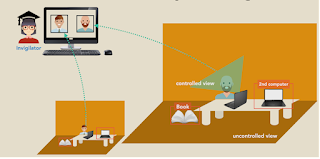
For many reasons students may be offered the possibility of doing their exams from their homes. However, we are not able to invigilate exams reliably because students’ computer webcams only cover a very small area of the home exam environment . It is almost impossible to detect any cheating when invigilators have to invigilate the exams of multiple students who are simultaneously doing their exams from home. We have elaborated an invigilator that uses AI techniques to provide real-time invigilation conditions similar to what happens in real life invigilation. It doesn’t require any expensive devices and respects the student’s privacy.  The student needs only a rotator that should be provided by his/her university. Currently we are building a controllable rotator that provides pan and tilt movements. This rotator will allow the smartphone to cover a bigger area inside the exam room to be controllable remotely by the invigilator. We are planning in the future to adapt the rotator to ...

statcert: a new tool to identify the type of X.509 certificates and their revocation status

Image
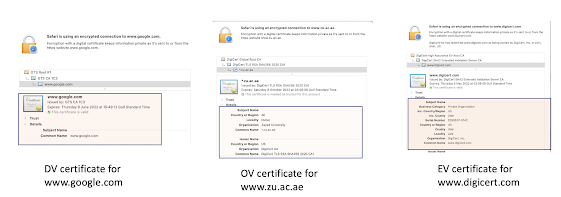
Today three types of certificates are used by the web: DV, OV, and EV. The DV certificates only ensure that the certificate owner has the right to control the domain name. Still, it doesn't provide any information about the owner's identity. On the other hand, the OV certificate lets one know that the owner has the right to use the domain name, but it gives more information about the domain name's owner, such as the organization name and the country. Finally, the EV certificates are similar to OV, but they provide more information about the owner, and the verification procedures of the owner information are more strict. Web users have to trust a website that uses an EV certificate more than a website that uses a DV or OV certificate. However, it is difficult for a web user to distinguish these certificates as the web browsers have decided to remove all the visual indicators for EV certificates. We have built a new tool called statcert that allows us to know the type of X.50...

Some issues in the management of Linux capabilities by AppArmor

Image
AppArmor is one of the most known LSM modules that allows the application of MAC access control rules. This tool is known to be easy to use when it is compared to SELinux.  As a part of my research work, I wanted to know how AppArmor manages Linux capabilities (administrative privileges for Linux).  So I have decided to build a shell script that requires administrative privileges and see how AppArmor can restrict this shell script. This work has allowed me to identify some important issues. My script includes two different commands that require two Linux capabilities: chown permits to change the owner of the file. This command requires the Linux capability cap_chown. nc -l 80 permits to create a process that listens to the port 80. This command requires the Linux capability cap_net_bind_service. Here is my shell script: #!/bin/bash if  chown test file1.txt  ; then      echo "owner changed"  else      echo "fai...